
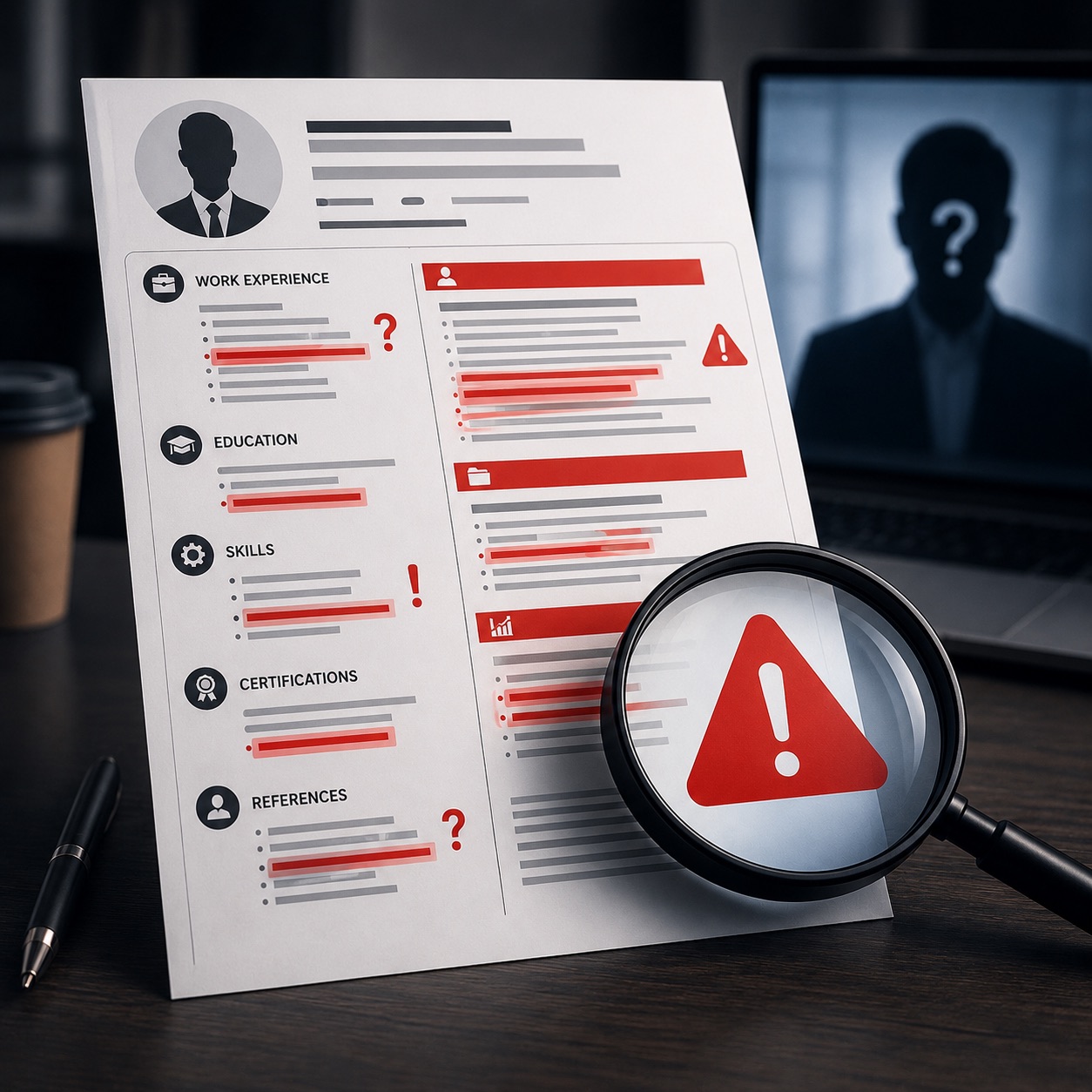
10 AI Candidate Fraud Signals Every Recruiter Should Watch For
Over the last 20+ years conducting interviews, I've seen candidates exaggerate experience, stretch job titles, and occasionally get caught in outright lies.
What's different today is the scale.
AI has dramatically lowered the effort required to create a convincing resume, generate interview answers, fake references, and even impersonate candidates during live interviews.
Candidate fraud is becoming a growing concern for Talent Acquisition leaders, particularly in remote hiring environments where identity verification is harder and AI tools are readily available.
Here are 10 signals recruiters should pay attention to.
1. The Resume Sounds Better Than The Candidate
The resume is detailed, polished, and perfectly aligned to the job description.
Then the interview starts.
The candidate struggles to explain projects they supposedly led or technologies they claim expertise in.
AI can generate excellent resumes.
It cannot create real experience.
If a candidate cannot explain how they personally solved a problem, that's worth investigating.
---
2. Every Answer Sounds Like A Blog Post
Experienced professionals typically answer questions using stories.
Fraudulent candidates often answer using definitions.
When asked:
Tell me about a production outage you handled.
You receive:
A production outage is a disruption of services that affects end users...
That's usually a warning sign.
Look for lived experiences, not textbook explanations.
---
3. Delayed Responses To Simple Follow-Up Questions
Many recruiters focus on the initial answer.
The real signal comes from the follow-up.
When candidates require several seconds to answer simple follow-up questions, they may be consulting another screen, AI tool, or external assistance.
The delay becomes even more obvious when the original answer was immediate.
---
4. Their Career Story Changes Throughout The Interview
Fraudulent candidates often memorize a script.
The problem is maintaining consistency.
Pay attention to:
- Employment dates
- Team sizes
- Technologies used
- Project ownership
- Reporting structure
Small inconsistencies often become larger ones as interviews progress.
---
5. The Candidate Cannot Go Deep
A strong candidate can continuously go deeper.
Ask:
- What happened next?
- How did you decide that?
- What alternatives did you consider?
- What metrics improved?
Eventually genuine experience becomes obvious.
Or the story falls apart.
---
6. Camera Behavior Feels Unnatural
This doesn't automatically indicate fraud.
However, recruiters should pay attention when candidates:
- Rarely look directly at the camera
- Constantly read from another monitor
- Frequently glance in the same direction before answering
- Appear visually different across interview stages
Several organizations have reported growing concerns around impersonation and deepfake-assisted interviews.
---
7. They Know The Technology But Not The Environment
Someone may know Kubernetes.
Someone who has actually operated Kubernetes in production knows:
- What broke
- What failed
- What they learned
- What they would do differently
The difference between knowledge and experience becomes obvious when discussing real-world situations.
---
8. References Feel Too Perfect
Fraud is no longer limited to resumes.
Organizations are increasingly reporting fake references and identity verification issues.
Watch for:
- References using personal email accounts
- Generic recommendations
- Reluctance to provide previous managers
- References that cannot discuss specific projects
---
9. Interview Performance Changes Dramatically Between Rounds
One interview is exceptional.
The next is surprisingly weak.
Or vice versa.
Large swings in performance should prompt additional validation.
Many recruiting leaders are implementing consistency checks across interview stages because candidate fraud often becomes more visible over time.
---
10. Follow-Up Questions Reveal Everything
The most effective fraud detection tool isn't AI.
It's a great interviewer.
Strong follow-up questions expose:
- Memorized answers
- AI-generated responses
- Resume embellishments
- Missing technical depth
The recruiters and hiring managers who consistently ask quality follow-up questions remain the hardest people to fool.
---
Final Thoughts
AI isn't going away.
Neither is candidate fraud.
The solution isn't adding more interview stages or creating more paperwork.
It's improving interview quality.
The best recruiters I've worked with don't rely on resumes.
They rely on curiosity.
Because the more specific the questions become, the harder it is to fake experience.
A Note For Recruiting Teams
One thing I've learned after conducting interviews for more than 20 years is that candidate fraud is rarely discovered by asking more questions.
It's discovered by asking better follow-up questions.
As AI-generated resumes and interview assistance become more common, recruiting teams are increasingly looking for ways to improve interview consistency, preserve interview context, and help hiring managers probe deeper into candidate responses.
That's one of the reasons we built MeetWiz.
MeetWiz listens during interviews, captures key context, and helps interviewers ask stronger follow-up questions in real time so teams can make more confident hiring decisions.
Learn more at: https://meetwiz.tech
---
Recruiters: What signals are you seeing during interviews today that weren't common 2–3 years ago?
#Recruiting #TalentAcquisition #Interviewing #Hiring #Recruiters #HRTech #ArtificialIntelligence #CandidateFraud #FutureOfWork #HiringManagers