
It's Time to Ditch the Resume: Introducing the P.R.O.O.F.X™ Framework
The resume is becoming one of the weakest signals in hiring.
Not because candidates are dishonest.
Because technology has changed.
Today, candidates can generate polished, keyword-optimized resumes in minutes. They can tailor them to every job posting, optimize them for ATS systems, and present themselves in ways that are increasingly difficult to validate.
At the same time, recruiters are facing record application volumes.
The result is a hiring process where candidates spend hours optimizing documents while recruiters spend hours reviewing documents, yet neither side gains meaningful confidence in whether the candidate can actually perform the role.
The Resume Arms Race
We're witnessing an arms race:
- Candidates use AI to improve resumes.
- Companies use AI to screen resumes.
- Candidates use AI to beat screening systems.
- Companies add more filters.
- Candidates add more keywords.
Everyone gets better at processing resumes.
Nobody gets better at evaluating talent.
The hiring industry has unintentionally optimized for document creation rather than experience validation.
The Real Problem Isn't AI
Most discussions focus on AI-generated resumes.
That's the wrong problem.
The real problem is that resumes were never designed to validate experience.
A resume is a marketing document.
If someone writes:
Led a cloud migration of 500 applications.
What does that actually mean?
- Did they lead the initiative?
- Did they own the architecture?
- Were they one contributor among fifty?
- Did the migration succeed?
- What metrics improved?
- What lessons were learned?
The resume doesn't tell us.
Yet hiring decisions often begin with those claims.
Why Recruiters Still Use Resumes
Because resumes solve a volume problem.
If 500 candidates apply to a position, recruiters need a mechanism to narrow the field.
The resume became the least-bad option available.
But when signal quality deteriorates, recruiters spend hours reviewing increasingly polished documents while struggling to determine which candidates genuinely possess the experience being claimed.
The issue isn't volume.
The issue is signal quality.
What Should Replace the Resume?
Not another form.
Not another assessment.
Not another keyword-matching algorithm.
A structured conversation.
Imagine a job posting where candidates don't upload resumes.
Instead, they spend ten minutes discussing their experience through a guided audio interview.
The system asks dynamic questions, follows up on vague answers, validates claims, and generates evidence.
The recruiter never has to listen to the entire interview.
They review the evidence.
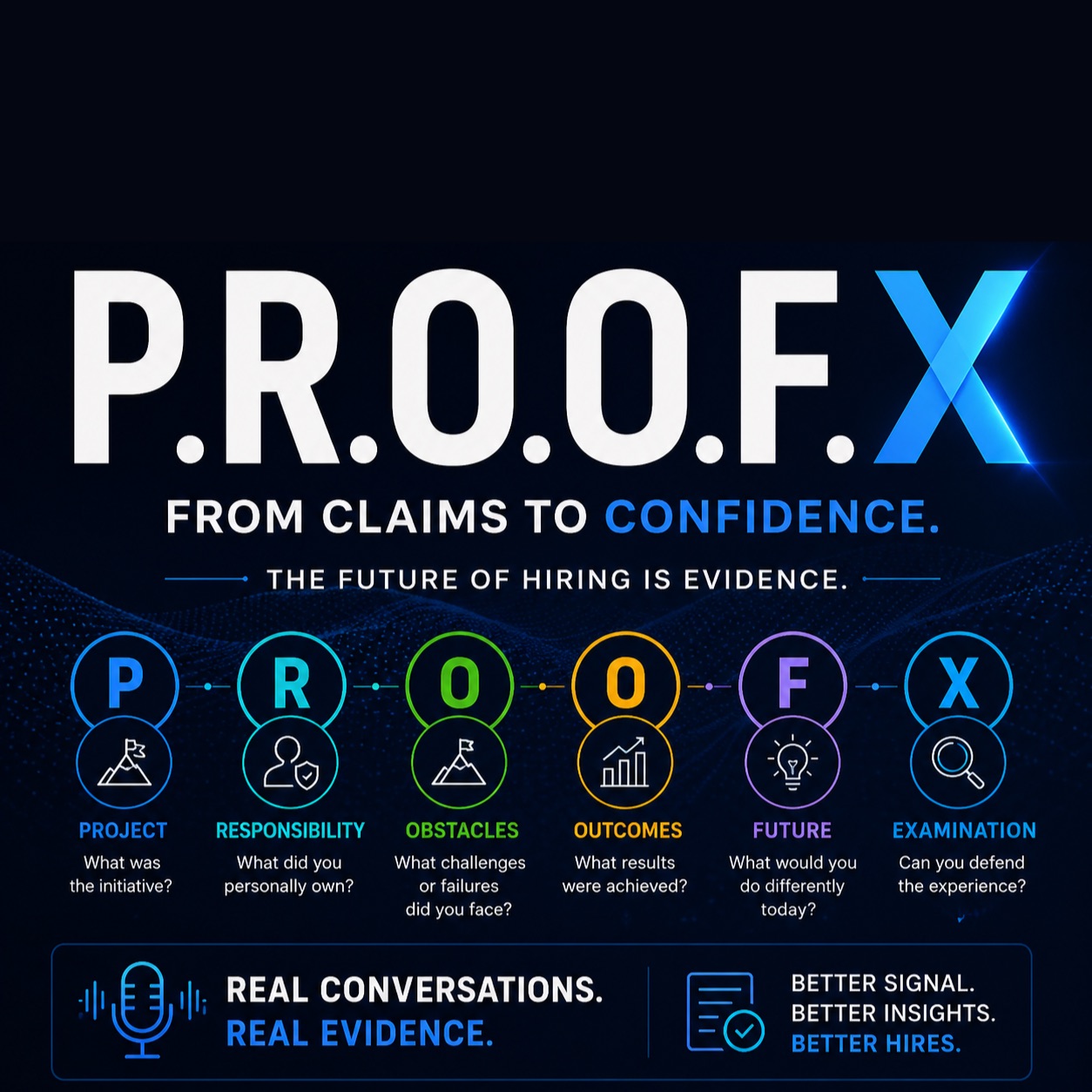
Introducing the P.R.O.O.F.X™ Framework
P.R.O.O.F.X is designed to transform candidate claims into validated experience.
P — Project
What was the initiative?
- Scope
- Timeline
- Team size
- Business objective
R — Responsibility
What did the candidate personally own?
- Decisions made
- Leadership responsibilities
- Deliverables owned
- Stakeholder management
O — Obstacles
What challenges, failures, or risks occurred?
- What went wrong?
- What was learned?
- How was the issue resolved?
O — Outcomes
What results were achieved?
- Business impact
- Technical impact
- Customer impact
- Organizational impact
F — Future
What would they do differently today?
- Lessons learned
- Mistakes identified
- Recommendations for others
X — eXamination
Can they defend the experience?
This is where AI asks adaptive follow-up questions.
For example:
Candidate:
We reduced cloud costs by 25%.
AI Follow-Up:
- What was the cloud spend before optimization?
- Which services generated the largest savings?
- What target was missed?
- Which initiative delivered the lowest ROI?
- What would you change if you repeated the project?
This is where experience becomes evidence.
Don't Score Candidates. Validate Them.
Most recruiting technology tries to answer:
Should we hire this person?
That's an extremely difficult problem.
A better question is:
Can this person substantiate the experience they claim to have?
That is a much more objective and measurable problem.
What Recruiters Actually See
Recruiters should never be expected to listen to hundreds of hours of candidate interviews.
That simply creates a new bottleneck.
Instead, they receive an evidence report.
Candidate Summary
Project Cloud modernization initiative involving 600 applications.
Ownership Platform architecture, migration strategy, vendor management.
KPIs Achieved
- 20% reduction in cloud spend
- 99.99% uptime
- 50% faster deployments
KPIs Missed
- Target: 30% cost reduction
- Actual: 20%
Reason Legacy applications required additional modernization effort.
Lessons Learned Application optimization should have started earlier.
Recommended Interview Questions
- Explain your FinOps strategy.
- Describe your disaster recovery testing process.
- How did you gain executive buy-in?
A recruiter can review this information in under a minute.
Why This Matters
For Candidates
- Less time formatting resumes.
- More opportunity to demonstrate expertise.
- Strong communicators stand out.
For Recruiters
- Faster screening.
- Better hiring signals.
- Consistent candidate evaluation.
- Reduced resume review fatigue.
For Organizations
- Better hiring decisions.
- Reduced false positives.
- Improved hiring efficiency.
- Greater confidence in candidate experience.
The Future of Hiring
The future application process may not be:
Upload Resume → Submit
It may become:
Conversation → Evidence → Validation
Resumes won't disappear overnight.
But as AI-generated applications become the norm, organizations will need better ways to validate experience.
The winners won't be the companies with the best resume filters.
They'll be the companies that can identify real expertise faster than everyone else.
This is one of the reasons we built MeetWiz.
MeetWiz helps organizations capture, validate, and summarize candidate experience through conversation rather than relying solely on resumes and interview notes. As hiring volumes continue to grow and AI-generated resumes become increasingly common, we believe evidence-based hiring will become more valuable than document-based hiring.
Learn more at https://meetwiz.tech
Discussion
If resumes disappeared tomorrow, what would you replace them with?