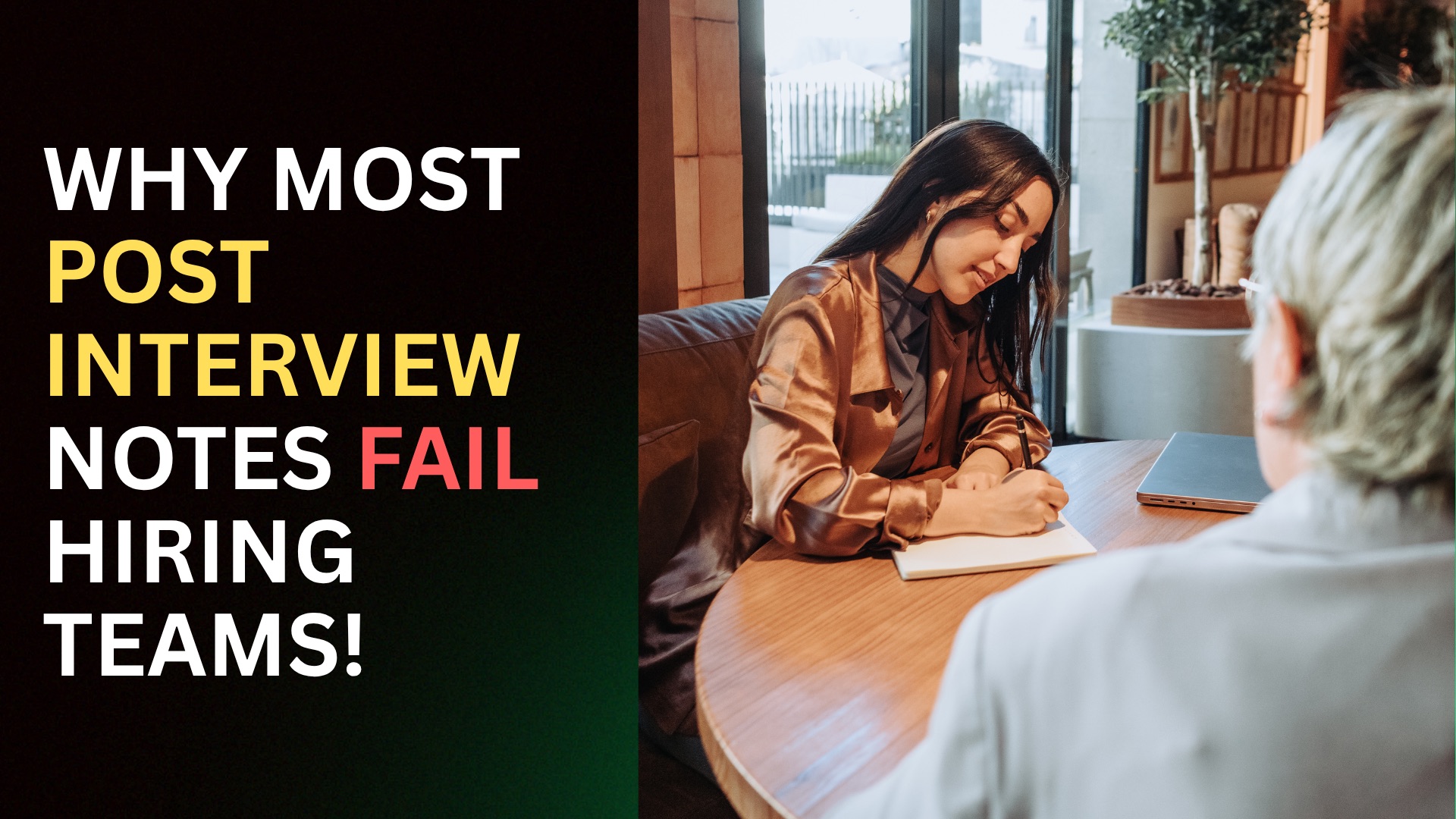
Why Most Post Interview Notes Fail Hiring Teams
Interview notes sit underneath every hiring decision your organization makes.
Scorecards. Debriefs. Candidate comparisons. Hiring manager discussions. Offer approvals. Rejections. Calibration meetings. Every one of those decisions ultimately depends on what was captured during the interview process.
When the notes are incomplete, the decisions become incomplete.
When the notes are inconsistent, the decisions become inconsistent.
And when the notes fail to capture the most important signals from a conversation, hiring teams inevitably fall back on memory, impressions, and intuition.
Most recruiting teams understand that notes matter. Yet many still treat note-taking as an administrative task rather than a strategic advantage. Notes are often written hurriedly between interviews, captured differently by every interviewer, and rarely structured in a way that helps the broader hiring team make better decisions.
That's the real problem.
The issue isn't that recruiters need better notes.
The issue is that hiring teams need better intelligence.
Notes are not the outcome of an interview. They are the input for every hiring decision that follows.
Why Interview Notes Matter More Than Most Teams Realize
Every hiring decision is ultimately a decision about evidence.
Not what the candidate claimed.
Not what the interviewer felt.
Not what someone vaguely remembers from a conversation three days ago.
It's evidence.
The challenge is that evidence disappears quickly. Human memory is imperfect. Details blur together after multiple interviews. Context gets lost. Important observations never make it into scorecards. By the time a debrief occurs, participants are often reconstructing conversations rather than evaluating them.
Strong interview notes create a shared source of truth.
When recruiters, hiring managers, and interview panel members can refer to the same evidence, conversations become more productive. Instead of debating what happened during an interview, teams can focus on evaluating what the evidence means.
The difference sounds subtle.
In practice, it's enormous.
The Problem With Traditional Note-Taking
Most recruiters face an impossible trade-off.
They can focus entirely on the candidate.
Or they can focus on capturing everything being said.
Doing both well is surprisingly difficult.
Anyone who has conducted a high-volume week of interviews understands the challenge. While a candidate is answering one question, the interviewer is already thinking about the next question, evaluating the current response, taking notes, watching the clock, and assessing fit for the role.
Something gets lost.
Sometimes it's eye contact.
Sometimes it's context.
Sometimes it's the most important follow-up question of the entire interview.
The traditional approach to note-taking forces recruiters into a constant battle between presence and documentation. Even the best interviewers struggle to maintain both simultaneously.
This isn't a training issue.
It's a bandwidth issue.
What Great Interview Notes Actually Look Like
Many teams confuse notes with transcripts.
A transcript captures everything.
A great note captures what matters.
The objective of interview notes isn't to recreate a conversation word-for-word. The objective is to preserve the signals that help a hiring team make better decisions.
The strongest interview notes typically contain four elements:
Evidence Supporting Candidate Strengths
- Key accomplishments
- Demonstrated skills
- Quantifiable results
- Relevant experience
Signals That Map to Hiring Criteria
- Leadership
- Communication
- Technical competency
- Problem-solving
- Stakeholder management
Risks, Concerns, or Gaps Requiring Validation
- Missing experience
- Unclear ownership
- Weak examples
- Potential red flags
Recommended Follow-Up Areas for Future Interviewers
- Areas needing deeper validation
- Open questions
- Missing evidence
- Competency gaps
Notice what's missing.
Verbatim conversation.
Most hiring teams don't need more words.
They need better signal extraction.
A concise, structured note containing meaningful evidence is often more valuable than twenty pages of transcript nobody will ever read.
The best interview note isn't the longest note. It's the one that helps the next person make a better decision.
Why AI Note-Taking Is Only Step One
The first challenge recruiting teams faced was capturing interview conversations consistently.
AI solved much of that problem.
Today, recruiters can record interviews, generate transcripts, and produce summaries with almost no manual effort. That's a meaningful improvement over scrambling to type notes while simultaneously trying to listen, evaluate, and build rapport with a candidate.
But better documentation doesn't automatically lead to better hiring decisions.
A transcript tells you what was said. It doesn't tell you which candidate examples demonstrate leadership. A summary can describe a project the candidate discussed, but it doesn't explain whether the candidate actually owned the outcome or simply participated in it. Hundreds of lines of conversation can be captured perfectly while the most important hiring signals remain hidden inside the text.
The real value of interview notes isn't preserving information.
It's helping hiring teams understand what information matters.
Great interview notes surface evidence. They highlight strengths, expose risks, capture motivations, and identify gaps that future interviewers should validate. They help hiring managers make decisions faster because they focus attention on the signals that influence hiring outcomes rather than the conversation itself.
From Notes to Interview Intelligence: MeetWiz
This is the shift we focused on when building MeetWiz.
Rather than viewing notes as documentation, MeetWiz treats notes as structured interview intelligence.
Every interview generates more than a summary. It generates evidence, patterns, candidate motivations, potential concerns, and opportunities for deeper validation. Those insights become useful not only for the recruiter who conducted the interview, but for every hiring manager and interviewer who participates later in the process.
The goal isn't simply to help teams remember what happened.
The goal is to help teams make better decisions because of what happened.
When interview notes become structured intelligence:
- Debriefs become faster
- Scorecards become more evidence-based
- Hiring manager alignment improves
- Candidate comparisons become easier
- Interview consistency increases across teams
- Hiring decisions become more defensible
Capturing a conversation is valuable. Understanding what the conversation means is where the real value begins.
The Future of Hiring Is Not Better Notes
The future of hiring is better evidence.
Great hiring organizations won't win because they captured more conversations. They'll win because they extracted more insight from those conversations than their competitors.
Interview notes will remain the foundation.
But the organizations that outperform will treat those notes as a strategic asset rather than administrative output.
The shift isn't from manual notes to AI notes.
The shift is from notes-as-documentation to notes-as-intelligence.
And that's where the biggest opportunity still exists for recruiting teams today.
---
Learn more at https://meetwiz.tech**